Super Mario Run
- 3.9
- Rating
- 100.00M
- Installs
- Free
- Price

 Analysis by App-foxy
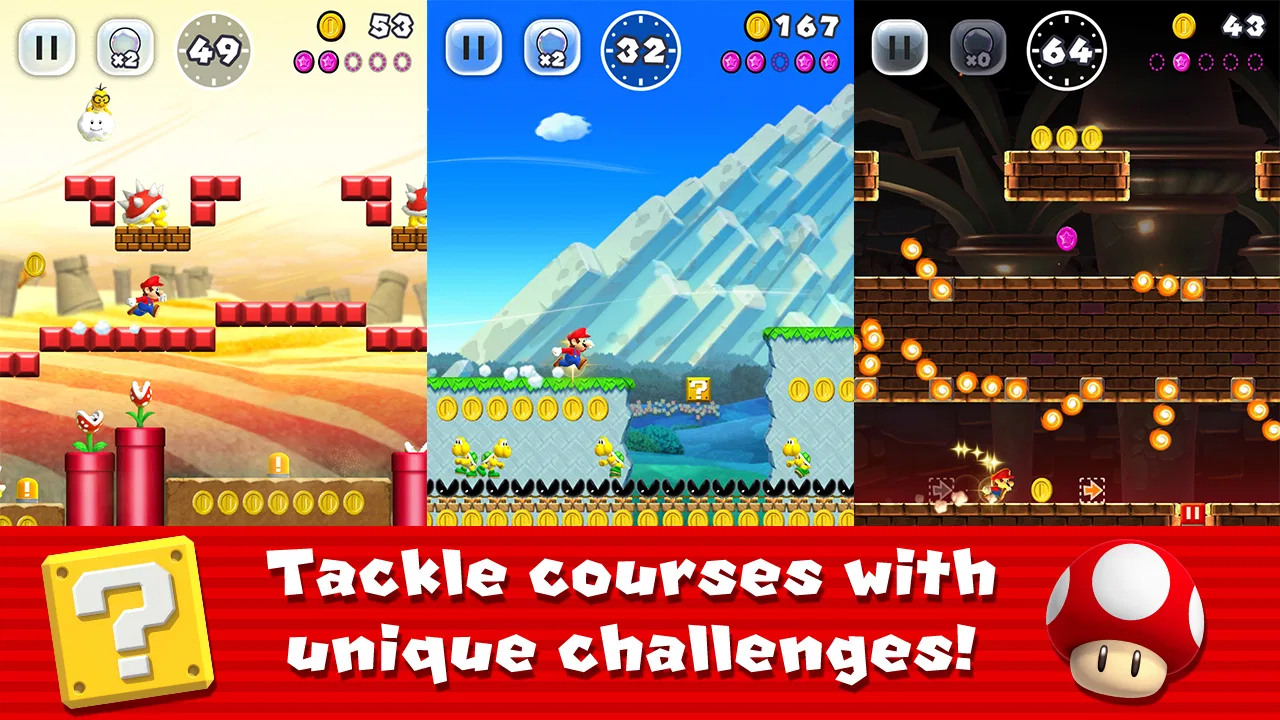
I expected Super Mario Run to feel like a simplified Mario game, but after spending time with it, I found a more focused idea: the game removes traditional movement controls and asks me to make better decisions with timing. Mario runs automatically, and I control him mainly with taps. That sounds basic, yet the best stages turn each tap into a small judgment about height, distance, momentum, and risk.
That design makes this a very approachable action game for Android and iOS, especially when I want something I can play with one hand. It is free to download, rated for Everyone, and made by Nintendo Co., Ltd. The large audience is easy to understand: the game is recognizable immediately, but it is not simply a passive version of a classic platformer. It expects attention, quick reactions, and a willingness to replay the same short section until the movement finally feels right.
How the first tap turns into a complete action loop
I look at the opening tap as the start of a compact decision cycle, not just a jump: I read what is ahead, choose how long to hold, then use the landing to prepare for the next obstacle. That makes it useful to focus on one immediate goal at a time, especially when a collectible tempts me away from the safest route. Once that rhythm is clear, the next question is where players tend to get stuck.
You May Also Like

 Blood Strike: 2.5 Anniversary
Blood Strike’s Loadouts Turn Every Drop Into a Tactical Gamble
A close look at Blood Strike’s custom loadouts: how fast access to signature weapons reshapes its battle royale rhythm, rewards preparation, and narrows the gap between fights.

 Pandora - Music & Podcasts
Pandora’s Music Is Easy to Start, but Harder to Recover
Pandora’s strength is its low-effort path from a seed to a station. Its weak spot is how much confidence it asks you to place in connection, setup, and quiet recovery.

 8 Ball Pool
 Is Built on Rivalries, Rematches, and Routine
A close look at the rivalries, rematches, shared routines, and unanswered safety questions that turn a quick pool match into a persistent mobile community.

 Samsung Music
’s Quiet Strength Is Playing What You Already Own
Its reach comes less from spectacle than from dependable access to a personal library. That simplicity is both the app’s strongest retention engine and its ceiling.

 AccuWeather: Weather Radar
AccuWeather Review: A Quick, Clear Forecast for Everyday Decisions
For everyday plans, the best forecast is the one you can understand quickly. AccuWeather makes rain timing, radar, and local conditions easy to act on, with a few trade-offs.

 Hill Climb Racing
Why Hill Climb Racing Still Turns Crashes Into One More Run
A tiny car, a bumpy hill and one more upgrade: Hill Climb Racing keeps resurfacing because its simple chaos makes every near-miss feel personal.
More From Our News Desk



The first action is simple, but the timing is not
When a stage begins, Mario keeps moving forward without waiting for a directional command. A tap makes him jump, and holding the tap changes the jump in a way that gives me more control over its height. That single input is the foundation of the whole experience. I am not steering Mario across a wide space; I am deciding when he should leave the ground and how much time he should spend in the air.
The result is surprisingly different from playing a conventional platform game with a virtual control pad. In a typical mobile platformer, I often fight the controls as much as the level. Here, the control scheme is less about walking and more about reading the path ahead. Platforms, enemies, gaps, and objects arrive in a steady stream, so my attention moves between what Mario is doing now and what the next jump will require.
The early stages are useful because they teach this rhythm without making every mistake feel harsh. I quickly learned that tapping at the last possible moment is not always the best choice. Sometimes an earlier jump gives Mario enough time to clear an obstacle, while a short tap helps him land sooner and continue safely. The game becomes more interesting when I stop thinking of a jump as an isolated move and start treating it as preparation for the next one.
That is the first important practical tip: do not watch only Mario's feet. I get better results by looking a little farther ahead, especially when several objects are arranged in sequence. The automatic running speed gives the game its urgency, but the level layout usually provides enough visual information to make a plan. The challenge is turning that plan into a tap before the opportunity disappears.
Feedback arrives immediately after every decision
The feedback rhythm is the strongest part of the design. A successful tap produces an immediate result: Mario clears an obstacle, reaches a higher route, defeats an enemy, or collects something placed along the path. A poor tap is equally clear. I may land in an awkward position, miss a collectible, collide with danger, or lose the chance to follow the route I wanted.
Because the game responds so quickly, I rarely feel confused about why a run went wrong. If Mario jumps too early, I can usually identify the gap in my timing. If he jumps too late, the result is just as obvious. That clarity matters on a phone, where a control system can otherwise feel vague or unpredictable.
The feedback is also visual rather than dependent on complicated menus. Mario's movement tells me whether the tap had the desired effect. A jump can become a bounce, a landing can lead into another jump, and a missed opportunity can change the rest of the run. I enjoy that the game keeps most of my attention on the course instead of interrupting the action with constant explanations.
Still, the one-input approach has a limitation. When I fail, I sometimes know what I wanted Mario to do but cannot express it because the game does not give me direct control over his horizontal movement. The level's timing and automatic path determine much of the outcome. Players who enjoy precise steering, stopping to inspect a platform, or choosing their own route may find this restrictive rather than elegant.
Why the reward is more than simply reaching the end
Finishing a stage is satisfying, but it is not the only reason to replay one. The game places optional objectives along the route, and these give familiar stages a second purpose. On my first attempt, I may concentrate on staying alive and reaching the finish. On later attempts, I can focus on collecting items that require a more deliberate jump or a less obvious route.
This creates a useful difference between completion and mastery. A safe run can show me that I understand the basic path, while a more ambitious run tests whether I can control Mario precisely enough to collect everything I noticed. The best rewards are often positioned where a normal jump is not enough. I have to adjust the timing, use an enemy or object as part of the movement, or accept that a safer route will no longer be available.
That structure is particularly effective for short sessions. If I have only a few minutes, I can attempt a stage without needing to commit to a long campaign. If I have more time, I can return to the same course and pursue a better result. The game therefore works both as a quick distraction and as a compact skill challenge, although the second use is much more rewarding for players who like repetition.
My practical advice is to choose one goal per replay. Trying to survive, collect every optional item, and improve the route all at once can make the run feel messy. I get more useful feedback when I first learn the safe path, then practice one difficult collectible, and only afterward combine those skills. That approach turns failure into information instead of making each restart feel random.
Different modes change what a successful run means
The main running stages are the clearest expression of the game's core loop, but the broader package gives the repeated action more context. The experience is not limited to endlessly pushing forward through one type of course. Other activities shift the emphasis toward competition, collection, or development, which helps prevent the automatic-running idea from becoming completely one-note.
One mode is especially useful when I want a faster test of my timing rather than a full stage attempt. Competing against another performance changes the emotional tone: I am no longer satisfied with merely finishing. I pay more attention to smooth movement, stylish actions, and the small choices that make one run better than another. It gives replaying a purpose even after I already know the route.
There is also a sense of progression outside the immediate run. Successful play can contribute to broader goals, giving me reasons to return after completing a stage. I appreciate that this makes the game feel less disposable, but it also means the experience is not purely about reaction speed. Some players will enjoy building toward longer-term rewards; others may prefer a straightforward arcade game where every session begins and ends with the score.
The free starting experience is enough to understand the controls and decide whether the loop suits me. The full experience involves an in-app purchase priced at $9.99 per item. I would not recommend paying simply because the Mario name is familiar. The sensible approach is to play the available portion first, check whether the automatic movement and replay-focused design feel enjoyable, and only then decide whether the additional content fits the way you play.
The reset is quick, which keeps mistakes from becoming frustrating
A good mobile action game needs to make restarting feel natural, and this one generally does. A failed run does not require a long recovery process. I can return to the stage and try again while the mistake is still fresh in my mind. That short distance between failure and another attempt is essential because the game expects me to learn through repetition.
The reset also changes how I judge risk. I am more willing to attempt a difficult jump when I know that failure will lead to another opportunity soon. This encourages experimentation with routes and collectibles rather than making me play every stage cautiously. The trade-off is that repeated attempts can become demanding when a later mistake forces me to repeat earlier sections that I already understand.
For everyday use, I found it best suited to small gaps in the day: waiting for an appointment, taking a short break, or playing briefly before putting the phone away. A stage can provide a complete little challenge without requiring the kind of uninterrupted time that a large role-playing game demands. However, the same structure can be less appealing during a long session, because the repeated running, jumping, failing, and restarting may begin to feel narrow.
There is another practical consideration for families. The age rating is Everyone, which makes the tone broadly accessible, and the controls are simple enough for a newcomer to understand quickly. Yet simple controls do not mean automatic success. Younger players may still need time to develop the timing required for optional objectives, and the purchase decision should be handled carefully if children use the device.
Who will enjoy it, and who should choose another game
I would recommend this game to someone who wants a polished, recognizable action experience that works well with one hand. It is a strong fit for players who enjoy improving a short run, chasing collectibles, and learning from precise mistakes. It is also a good introduction to platform-game ideas for someone who finds traditional touch controls uncomfortable.
I would be more cautious about recommending it to players who want open exploration or full control over movement. If your favorite part of a platformer is stopping to line up a jump, changing direction instantly, or discovering your own route through a large level, the automatic running may feel like a compromise. A conventional platformer with a virtual directional pad will offer more freedom, even if its touch controls are less elegant.
It is also not the best choice if you dislike replaying familiar content. The game gets much of its value from returning to stages with better timing and more ambitious goals. Someone looking for a constantly changing action game may find the loop repetitive, while someone who enjoys shaving mistakes out of a route can find a surprising amount of depth in the same short course.
The game's public reception reflects a very large player base, with an average rating of 3.9 from around 1.7 million ratings and more than 90,000 written reviews. I read that combination as a useful warning not to assume that the famous character makes the design universally appealing. Many players can appreciate the polish while still disagreeing about the automatic controls or the way the paid content is presented.
Performance, availability, and what to expect before installing
The game was released on March 22, 2017, and the current version is 3.3.2. It supports devices running Android 6.0 or later. That makes checking the operating system worthwhile before installing, especially on an older phone or tablet. The title has passed the novelty stage and has received enough attention to remain a familiar mobile release, but its age also means I approach it as an established, focused design rather than a constantly surprising new one.
It is free to install, with optional purchases priced at $9.99 per item. That pricing is important to the decision because the free entry point and the complete experience are not the same commitment. I would treat the initial download as a test of the control philosophy, not as proof that the entire game will suit me. If the first stages make me want to replay them immediately, the purchase has a clearer justification.
The install base has grown beyond 100 million, which explains why it is easy to encounter as a recommendation for casual action gaming. Popularity does not remove the design trade-offs, though. The game is successful at making one tap meaningful, but that same simplicity can feel limiting after extended play. I value it most as a compact challenge rather than as my only mobile game.
My verdict on the action, feedback, reward, and reset
My final impression is that the game succeeds because every part of its loop supports the next attempt. I tap to act, see the result immediately, receive a reason to improve the run, and restart before the lesson disappears. That chain is easy to understand but difficult to master, which is why a stage can remain interesting after I have already reached its end.
The real strength is not that Mario runs automatically; it is that the restriction gives every tap a clear consequence. The design turns movement into timing, and timing into a repeatable skill. When the level layout gives me a fair chance to read what is coming, the game feels responsive and satisfying. When I want more freedom than the fixed movement allows, I notice the limitation immediately.
I would install it for short, focused sessions and recommend trying the free portion before considering the $9.99 purchase. It is a particularly good choice for fans of precise replay and quick action, while players seeking exploration or traditional platform controls should look elsewhere. Nintendo's recognizable character helps draw me in, but the reason I return is more specific: one more run usually feels like a realistic chance to correct the last mistake.
For me, that makes Super Mario Run a worthwhile mobile action game with a clear identity. It is not a replacement for every kind of platformer, and its purchase model deserves a deliberate decision, but the core loop is unusually clean. A tap creates movement, movement creates feedback, feedback suggests a better route, and the fast reset makes trying again feel inviting rather than burdensome.
FAQs for Super Mario Run
01Is Super Mario Run free to play?
Super Mario Run is free to download, and you can play the first few levels without cost. However, to access the full game, you'll need to make a one-time purchase. This model allows you to try before you buy, providing a taste of the gameplay before committing to the full experience.
02What devices are compatible with Super Mario Run?
Super Mario Run is available on both iOS and Android devices. For iOS, it requires iOS 8.0 or later, making it compatible with iPhone, iPad, and iPod touch. On Android, you'll need a device running Android 4.4 or higher. Ensure your device meets these requirements for optimal performance.
03Does Super Mario Run require an internet connection?
Yes, Super Mario Run requires a stable internet connection to play. This is necessary for syncing game data, accessing certain features, and maintaining game security. It's important to be connected to Wi-Fi or have a reliable mobile data connection to enjoy uninterrupted gameplay.
04Can I play Super Mario Run offline?
Unfortunately, Super Mario Run cannot be played offline. The game requires an active internet connection for gameplay. This means you need to have access to Wi-Fi or mobile data to play, which might be a consideration if you plan to play on the go without reliable internet access.
05What are the main features of Super Mario Run?
Super Mario Run offers several modes, including World Tour, Toad Rally, and Kingdom Builder. In World Tour, you'll navigate through classic Mario levels. Toad Rally lets you compete with friends and other players, while Kingdom Builder allows you to customize your own Mushroom Kingdom. Each mode provides a unique twist on the traditional Mario experience.
Pros
- Engaging gameplay with classic Mario charm.
- Simple controls suitable for all ages.
- Offline play available for convenience.
- Frequent updates keep content fresh.
- Variety of levels and challenges.
Cons
- Requires internet for certain features.
- In-app purchases can be costly.
- Limited free content without purchase.
- Battery usage is relatively high.
- Gameplay might feel repetitive to some.

Super Mario Run
Gallery